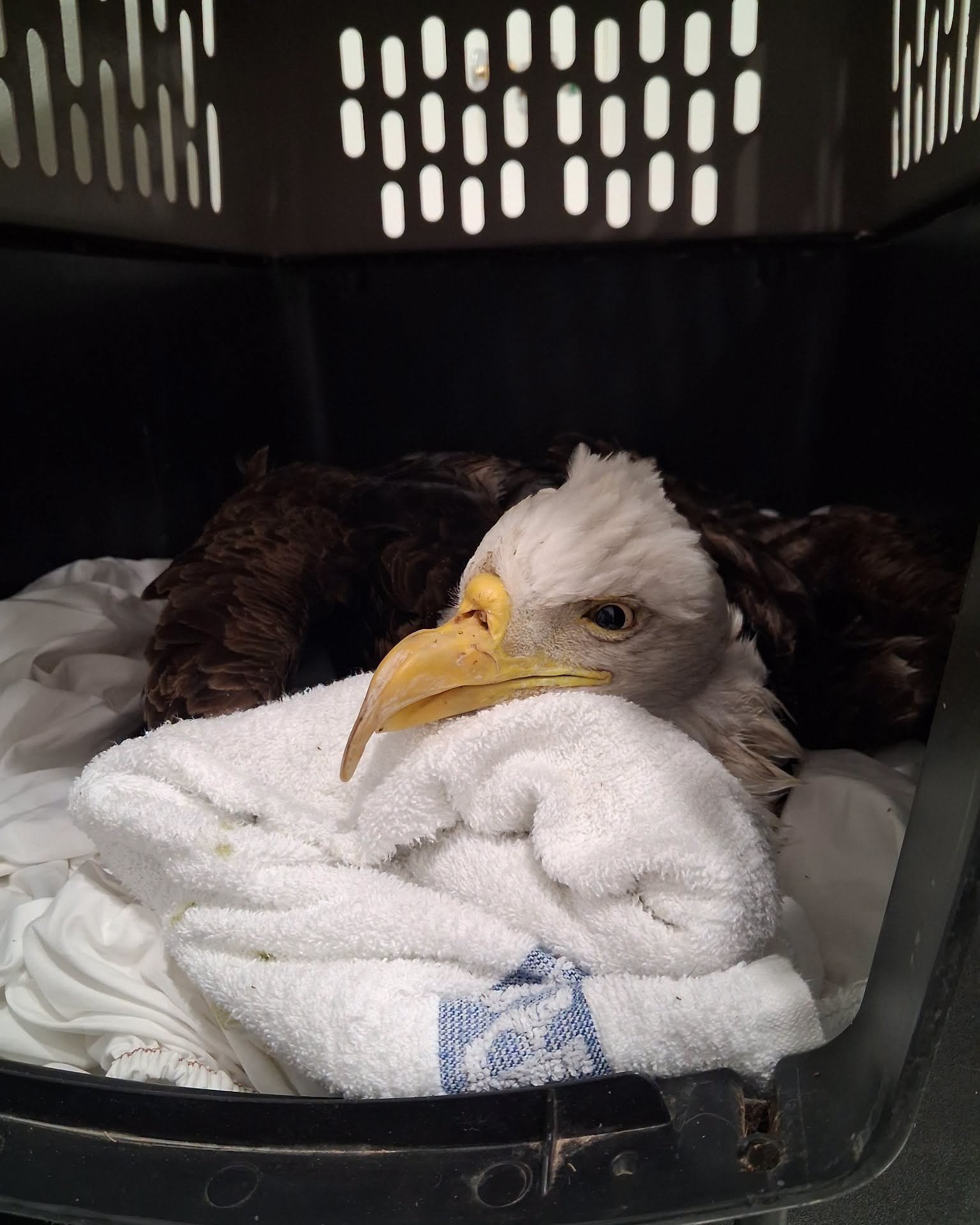
Photo Credit: Raptor Center
RAPID CITY, S.D. (KELO.com) – A locally famous female Bald Eagle that community members nicknamed “Hope”, due to an upper beak deformity, died of lead poisoning on Monday, Oct. 19, despite rehabilitation efforts. Hope and her mate had just returned to Canyon Lake in western Rapid City, for their 9th winter nesting season, a few weeks prior.
The Black Hills Raptor Center received a call from a concerned resident near Canyon Lake in the late afternoon of Sunday, Oct. 18. Hope was brought to the center in critical condition, her symptoms including extreme lethargy and trouble breathing. Hope passed the next morning.
Hope was well-known in the Rapid City area because of her unique beak providing an easy way to identify her. She was well-documented by wildlife photographers and birders who have monitored her and her mate through the last nine winters.
Tissue samples were sent to North Dakota State University for a necropsy to test for lead poisoning, West Nile Virus, and Highly Pathogenic Avian Influenza (HPAI). The findings confirmed Hope did not have HPAI or West Nile Virus, but had 22.6 parts per million of lead concentration in her liver. A concentrate of 10 ppm is considered severe poisoning by NDSU.
The exact source of the lead in Hope’s case is unknown, but lead toxicity is a widespread issue for eagles and other scavenging wildlife. Most hunting ammunition contains lead, and when shot, can splinter into over 700 shards inside a deer, elk, or other target. Opportunistic eaters like bald eagles will scavenge the lead-ridden gut piles left behind by hunters.
Another way eagles could encounter lead is by accidentally ingesting lead fishing sinkers.
BHRC Executive Director Maggie Engler said, “Hope was an iconic bird in the Rapid City area. We are very saddened by her passing. Hunters and anglers can switch to non-lead ammunition and fishing tackle so that other wildlife do not die of lead poisoning. Learn about the new program in South Dakota, called Hunt Lead Free SD, to help you explore the transition to non-toxic ammunition.”








Comments